The Forgotten War in Afghanistan
While the world has been transfixed by the war on ISIS, the US have been intensifying the war in Afghanistan in the shadows.
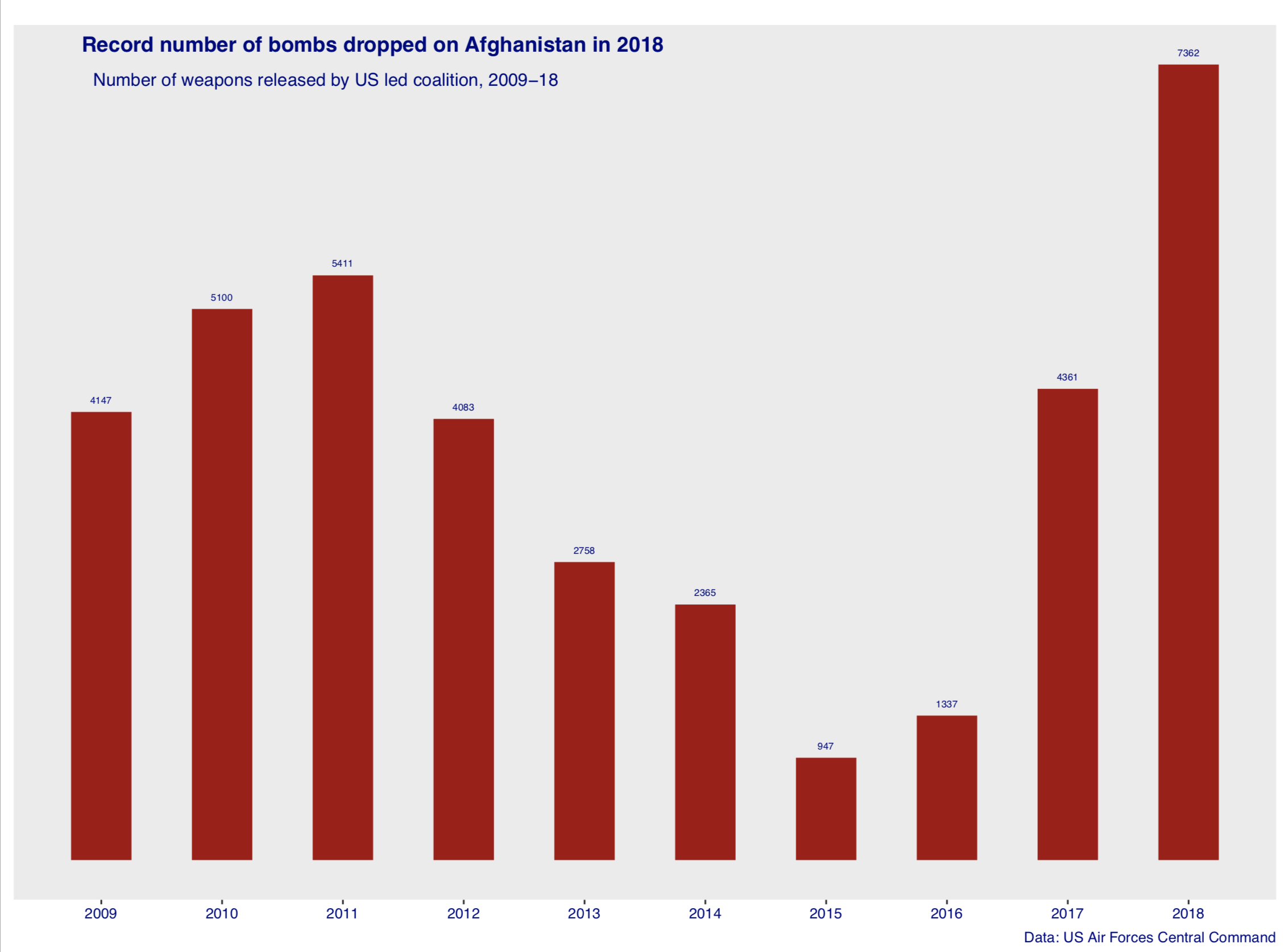
2018 saw the US drop more bombs than in the last 10 years, the highest civilian casualty rates since the war began and airstrikes spread geographically across the country.
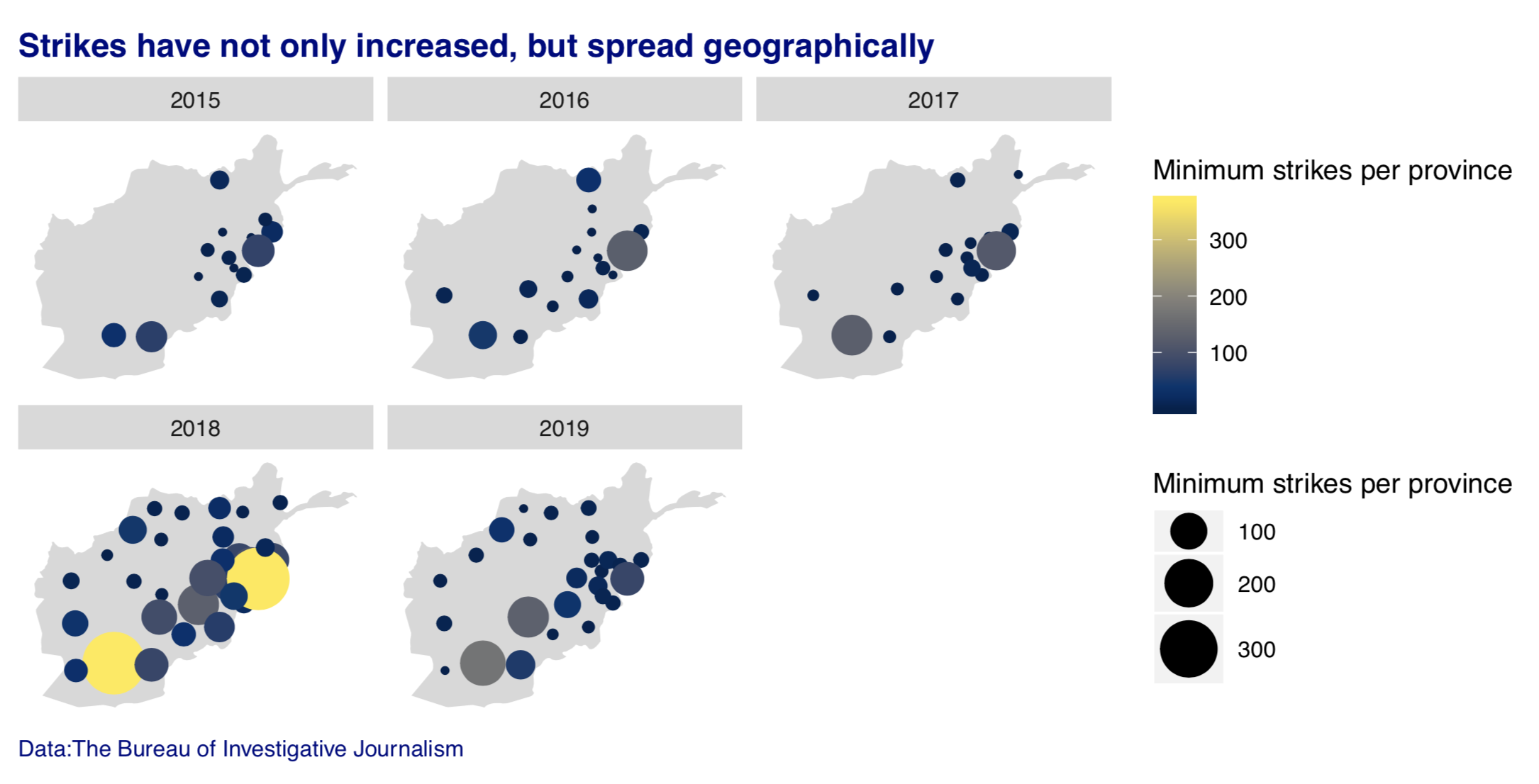
We've mapped the violence from airstrikes alone.
17 years into the war and Afghanistan is more dangerous than ever
With Afghanistan rarely making the daily news cycle, you wouldn't be remiss to assume that the height of the Afghan war was 2009-11 - when it featured in the news as much as the war in Syria does today.
However, Afghanistan has never been less secure. The Taliban control more territory now than they have since the overthrow of the regime, almost 18 years ago.
The retaliation from the US-led coalition has been huge. In 2018 the US conducted 12 x more sorties in Afghanistan than they did in 2015. In fact, 2018 saw a record year for civilian harm in Afghanistan, since the UN began counting in 2009.
The rise of ISIS-K (Afghanistan's branch of the so-called Islamic State) has likely had significant influence in the spike of the violence. In fact a recent UN report claimed that the Taliban were responsible for 37% of civilian harm and ISIS-K, 20%.
While media coverage of US conflicts has been dominated by the US-led Coalition in Iraq and Syria since 2015, the war in Afghanistan has been intensifying exponentially.
A closer look at the geography reveals alarming details.
Airstrikes have always been the most intense in southern and eastern Afghanistan - the provinces that border Pakistan. Particularly in Helmand and Nangarhar, which are Taliban strongholds. Even today, the Taliban controls 80-90% of the districts in Helmand.
However, when mapped the geography of the violence shows that whilst airstrikes are still at their highest in these provinces - the violence is quickly spreading West towards the Iranian border.
“The difference I noticed wasn’t a change in the pace of operations or a build up and draw down. It was more where we were … flying into. It was where the fight was being fought,” said Capt. Michael Morrison,
a C-130J pilot with the 41st Airlift Squadron. Morrison couldn’t say exactly where the fighting was taking place, but he said the more remote, mountainous areas did not have “a suitable airfield, so we have to
do the airdrop instead.”
Air Force Magazine
Both the intensifying of strikes and the geographical spread has had catastrophic consequences for civilians. In 2018 alone, the war caused 3,804 civilian deaths and 7,189 injuries in the fighting between the US & Afghan forces, the Taliban, ISIS-K and other anti-government armed groups.
"More than 32,000 civilians have been killed in Afghanistan in the last decade".
QZ.com
Investigations by the Bureau of Investigative Journalism have shown that more and more of the strikes to try and disseminate the Taliban are hitting buildings - making it near impossible for those launching them to see who is inside.
While it's commonplace in conflict zones where airstrikes are heavily relied on, for civilians to seek refuge in another part of the country, the above maps show that strikes are now enveloping almost all of Afghanistan.
There is no doubt that the Taliban and other extremist groups in Afghanistan are causing the bulk of civilian harm, however, they are pushing the US into strikes that are increasing their own casualty rates. The UN Mission in Afghanistan have recently claimed that there were 632 civilian casualties from international military actions in 2018 - 393 deaths, 239 wounded - that's 6% of all civilian casualties.


