The essential guide to sharing your story on social media

Social media is all about visibility, but the key for digital journalists is realising that each app promises a different kind of visibility because they reach different communities and content is presented to them in different ways. This guide will break down how content should be shared on Facebook, Twitter and Instagram, with case studies providing you with the do’s and don’t’s on each app.
Facebook
Following the change in Facebook’s algorithm last year, the platform now prioritises “meaningful interactions” through comments, replies and direct engagements (through shares) with posts. For journalists pushing out content, this is dissimilar to how we view posts on Twitter and Instagram (as we will see later), which act as quick bursts of information.
Therefore, the best content for Facebook will initiate direct conversation, which can be difficult for news outlets to achieve where there is so much content to push out, and a certain pace to keep up with. The Sun manages to balance content bursts with “meaningful interactions” through captions that directly appeal to their audiences.

The story itself is an already topical one that appeals to the target audience’s Facebook users, who use the platform to discuss. The added humour in the caption adds a new layer that encourages sharing because of the way it encapsulates the everyday human voice interacting with their friends on Facebook. A caption that feels distant from its audience almost feels as though the journalist is talking down to them rather than with them — making this small stylistic change could mean the world of difference in the eyes of the algorithm.
Think about this before posting
Stories for Facebook will gain the visibility that the journalist wants if it can answer two questions: 1) Are there communities on here that care about this? 2) Can my caption give it the angle that will make them want to share it?
Twitter
The speed and chronological presentation of the Twitter feed means that it is the most popular form of storytelling for journalists, and is often where audiences look to first for updates and breaking news.
The character limit (though extended to 280 characters from 140) means that audiences expect quick bursts of information that are easy to digest, almost like the traditional NIB (news-in-brief) that we find in print. The difference is that tweets aim to add to wider conversations, with each news outlet’s stories offering its own perspective on a current trend or hashtag. The aim here becomes trying to stand out in a huge pool of information.
Think about this before posting
The journalist must consider what is new about the story they are tweeting, what it adds to the bigger picture. The ability to showcase a story’s newness directly through the app has come from the use of the thread (check out fellow Interhacktive Francesco’s piece on Twitter threads) because of the way it advertises points of discussion that the news stories being shared have to offer to wider debates. As you would expect, this is valuable particularly for investigative pieces, as seen here with a thread by the New York Times.
Taking an already topical figure in the Twitter space and breaking it down through a thread, rather than just a link to the investigation on the site, offers a new take in the online debate where the thread could be used as areferencebecause of the easy access to the fresh thoughts and perspectives being offered.
The New York Times’spoliticseditor Patrick Healy is using Twitter threads for transparency in the paper’s editorial choices. His hope is to help readers engage better with the stories being pushed out on the app.
Using Twitter to push ongoing debates, and start new conversations by sharing perspectives and ideas alongside your stories makes the platform incredibly valuable for journalists, both in enhancing the quality of the news outlet they are writing for, and also in building their own personal brand.
Instagram
All platforms include an element of visual storytelling. But Instagram is the only one of the three that is heavily reliant on it. For stories where a photo or video are the mainfocus,or stories that are supported by strong visuals, Instagram is the right space to push out such content. An example of this is the recent news story of a fan tattooing Harry Styles onto her face.
The story works for Instagram because the story relies heavily on the visual element, and allows a more emotive response form its audience than text would. But, as with Facebook posts, captions are key, and can change the amount of likes and comments dramatically. This is important for Instagram, where its algorithm pushes at the top posts that a user’s followers are interacting with the most. Given the huge Harry Styles fanbase that already exists this is already content made for sharing, but pushing the audience to actually engage with it comes from the second layer of how the journalist/news outlet is working to reach the people that will share, which we can see when comparing the picture on two different news sites:
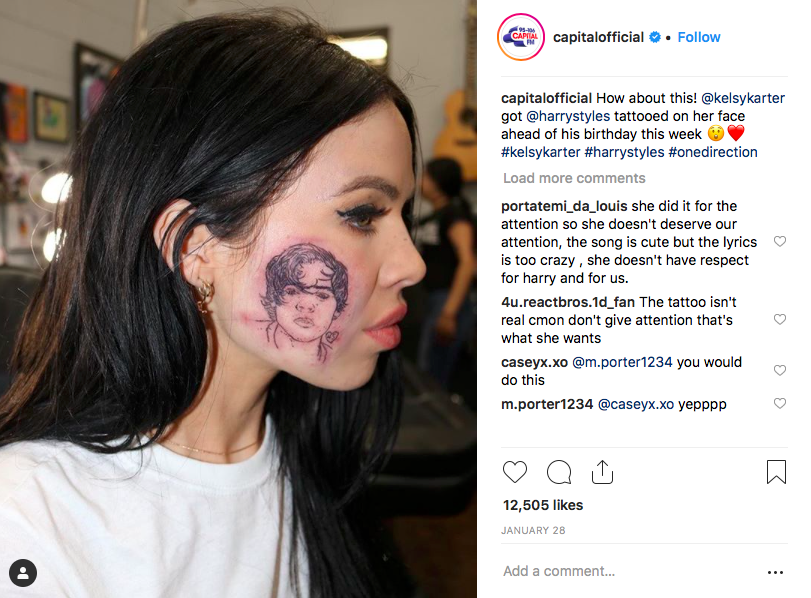

Capital’s use of relevant hashtags shows a better understanding of its target audience as being fans of Harry Styles (who follow the tag) and other music lovers that will want to share this. While The Sun does encourage commenting through questions, its caption limits audiences and does not guarantee as much reach and interaction.
Think about this before posting
Interaction and engagement are key for measuring success on Instagram. Both can also be obtained using Stories to present your content in a more interactive way. Through questions, poll and slider tools, journalists and users establish a direct relationship. A great example is Fake or Real stories by The Guardian.
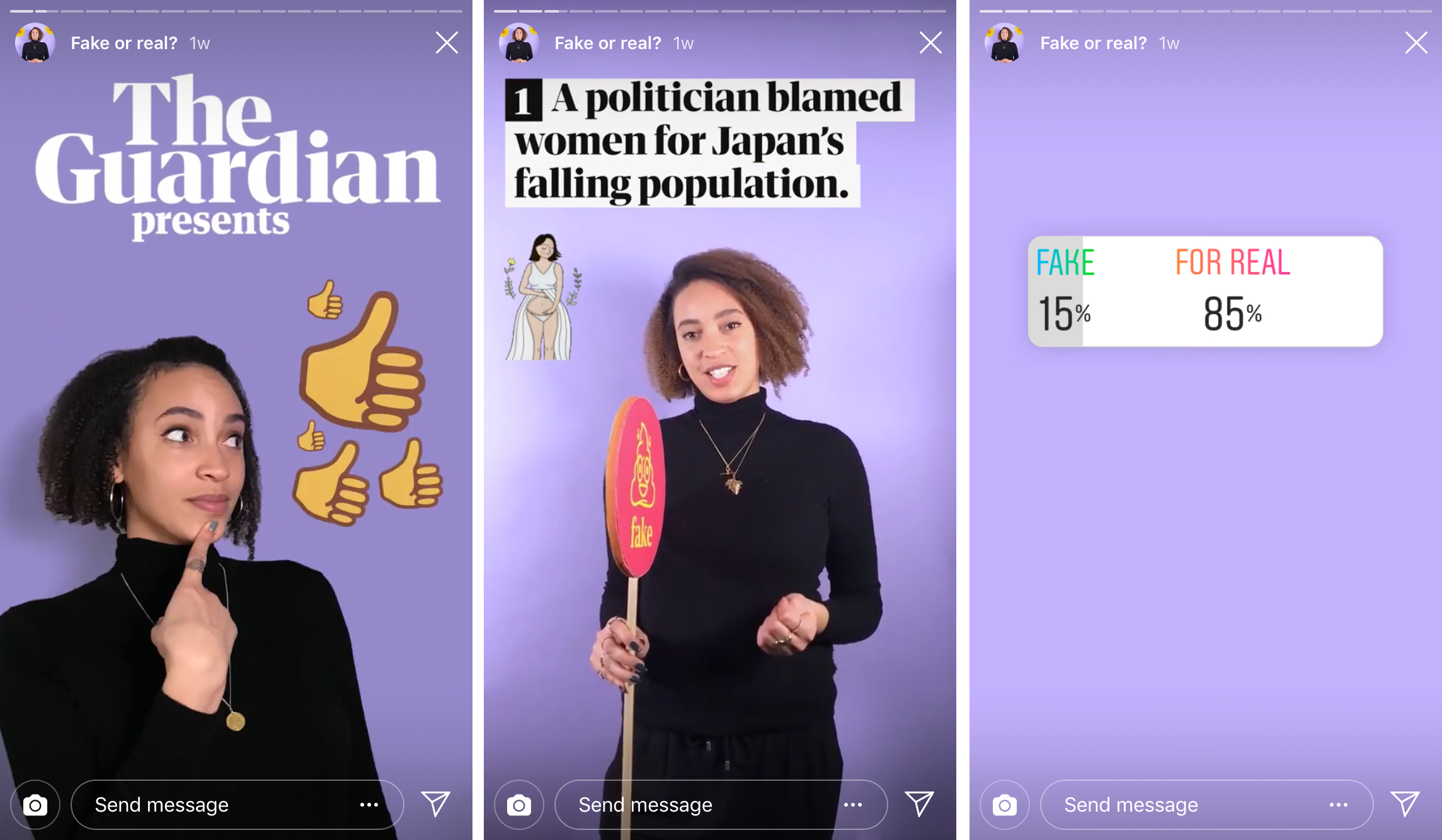
Here journalism becomes an interactive experience for its users while encouraging to share and discuss it. These tools help you monitor based on how many have come back to interact.
As we have seen, making content visible by turning it into an active experience for users is the key. But across each platform, how visibility is defined is different. By taking the time to question who you are trying to reach with your stories, these goals can be met.


