Interview: Luke Barratt, investigative journalist at Unearthed
Luke Barratt on how he wrangles data to find exclusive stories and why data literacy is important.

Unearthed is Greecepeace's investigative journalism project. We spoke to Luke Barratt, part of the award-winning team, about their work.
What’s a typical day like as a reporter for Unearthed ?
It depends what stage I'm at in an investigation. Early on, I'll be calling and going out to meet sources and doing research online to figure out how the investigation is going to work, what FOIs I should put in, what are the most promising lines of enquiry, etc.
As it progresses, I might be sifting through documents to find the most interesting parts or working through data to make it relevant. Sometimes I might spend several days in a row just working through some data, if there's significant work that needs to be done to make it work for the story. Where it gets really hectic is nearer the deadline for the investigation, when I'll be trying to write up the story, dealing with responses and denials from press officers and fielding difficult queries from my editor and partner media outlets.
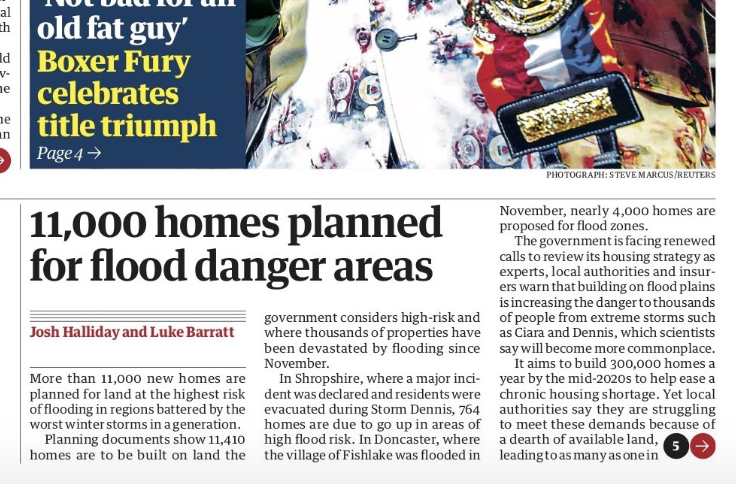
Could you talk us through the methodology which went into your exclusive story with the Guardian which revealed that more than 11,000 homes are to be built on land at high risk of flooding? How did the story develop from an initial pitch to the front-page?
This came out of a previous story I worked on with BBC Radio 4's Today Programme on planned housebuilding in high flood-risk areas at the end of last year. For that story, I downloaded shape-files for the EA's national flood-risk map and used QGIS to analyse them. I layered local authority boundaries over it and used the programme to calculate which local authorities had the highest percentage of land covered by high-risk areas. I selected the top 10 by this metric to look at further. I then found those councils' local plans and went through their list of housebuilding sites, plotting them on the flood-risk map to see how many homes were planned for those areas. If it wasn't clear from the address what flood area it was in, I looked the development up on the council's planning portal to find the exact site boundaries. If a site was at least 50% covered by a flood-risk area, I recorded it as being in that area. As I was doing the investigation, Sheffield and Doncaster were hit by particularly bad floods and so I included those two local authorities as well.
For the Guardian, I repeated the methodology but looked only at all local authorities that had been affected by the winter's floods, that is, the pre-Christmas flooding and storms Ciara and Dennis.
Generally, how do you find your stories and come up with ideas?
It's very useful to read everything in the news and think as you read the story whether there is an angle that the journalist has not considered that would merit further investigation. If a topic is already in the news, it's clearly newsworthy, and there will very often be elements that haven't been fully addressed which are worth looking into.
Unearthed does collaborations with publications such as the Guardian and the FT - how does this collaborative form of journalism work logistically?
It varies. Sometimes outlets will come to us with an idea of something they want to work on, which is what happened with the Guardian story mentioned above. In cases like that, an Unearthed reporter will typically work together with a reporter from that outlet, dividing up the work. At other times, we'll pitch a fully-formed story to a specific outlet where we think there might be interest. In those cases, the Unearthed reporter will still have to communicate extensively with other journalists, who will obviously want to understand the details of the story and how we've got it.
How do data journalism techniques come into your reporting?
I'm not a particularly advanced data journalist. I don't use coding (sorry to my old tutors). But data literacy is important. I often deal with data that I've obtained through FOI or other means and knowing how to use an array of Excel functions means I can manipulate data and see how it can be turned into a story. Even though I don't code myself, having a basic understanding of how HTML works is helpful, as it's not uncommon to come across information in .txt form. The other thing that's particularly useful - and I don't know if this counts as data journalism - is knowing all of the different search functions that Google has.
Follow Luke on Twitter here


